Author: katie@loamy.app

  • Wood Chips vs. Mulch: Which One Is Right for Your Landscape?

    Wood Chips vs. Mulch: Which One Is Right for Your Landscape?

    If you’ve ever stood in a garden center or scrolled through a landscaping supply site wondering whether to choose wood chips or mulch, you’ve probably realized the answer isn’t as straightforward as it seems. The two look similar, often cost around the same, and get used in overlapping ways. 

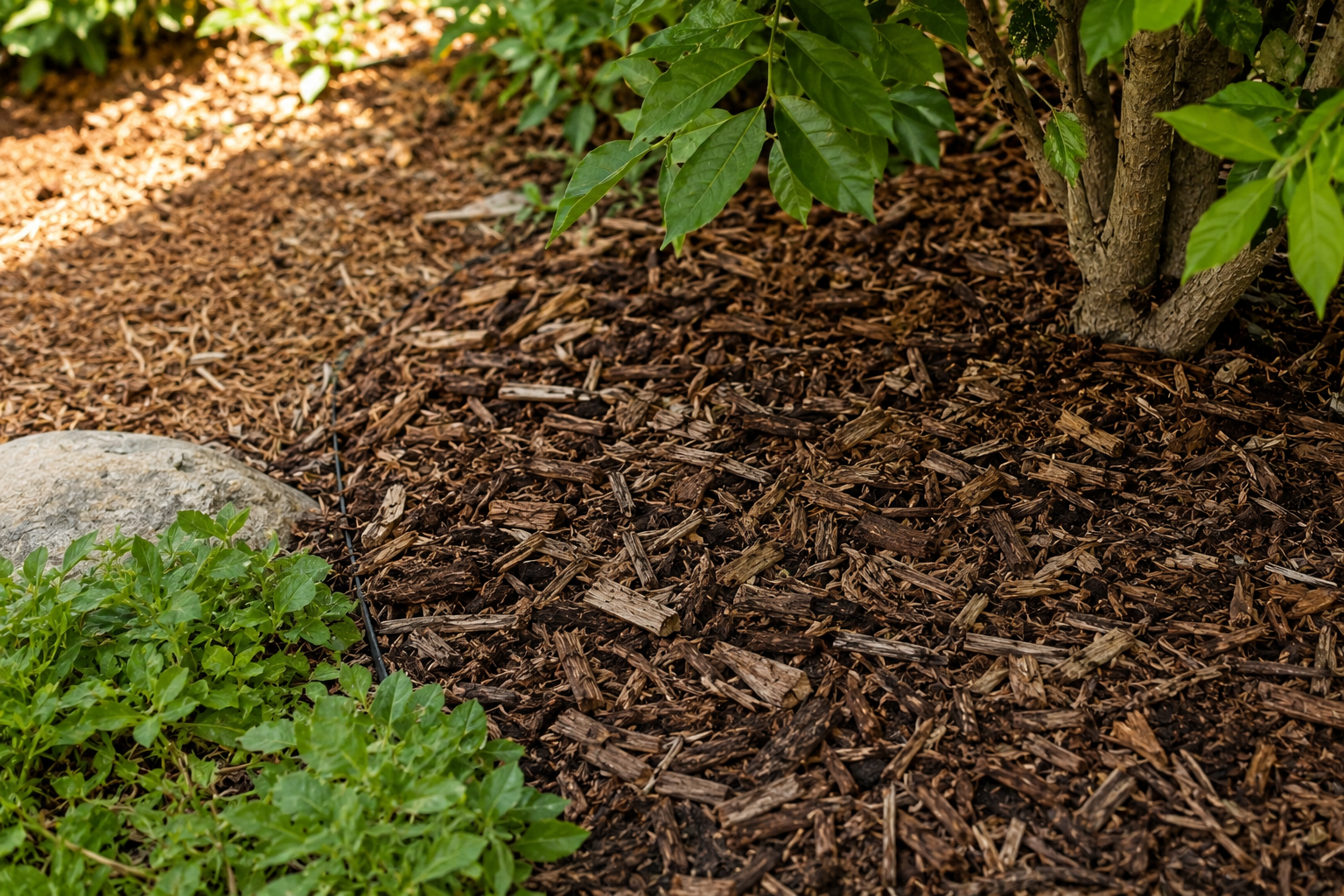
    Technically, wood chips are a type of mulch, but when most people compare wood chips vs. mulch, they’re usually comparing wood chips with shredded bark mulch. Understanding the main differences will help you choose the best mulch for your specific needs, whether you’re refreshing your front yard, protecting plant roots, or covering a long garden path.

    This guide breaks down what separates wood chips from shredded bark mulch, where each one excels, and how to choose the best option for your landscape.

    Key Takeaways

    • Mulch is a broad term for any material layered on the surface of the soil to retain moisture, suppress weeds, regulate temperature, and help reduce soil erosion. Wood chips are just one type.
    • Wood chips are coarser, chunkier, and slower to break down, making them an excellent ground cover for pathways, around mature trees, and naturalized areas.
    • Shredded bark mulch is finer, breaks down faster, and is better suited for garden beds where appearance, plant growth, and soil health are priorities.
    • Both are organic materials that improve landscapes, but each is the best choice for different applications.
    • Ordering bulk mulch or bulk wood chip mulch is almost always more economical than buying bags from retailers like Home Depot.

    What is mulch?

    Mulch is a catchall term, not a specific material. Technically, anything you spread across the surface of the soil to protect or improve it qualifies as mulch. There are both organic and inorganic mulch options, although most homeowners choose organic materials because they gradually improve the soil as they decompose.

    When most homeowners say “mulch,” they’re referring to shredded bark mulch—the dark, finely shredded material commonly used around shrubs, trees, and flower beds. It comes in different grades (fine, medium, or coarse) and may be dyed black, brown, or red, or left natural.

    As one of the most popular kinds of mulch, shredded bark breaks down relatively quickly, usually within one to three years depending on the material and climate. During that time, it adds organic matter, supports soil nutrients, improves drainage, and encourages healthy soil biology.

    Common mulch options include:

    • Shredded hardwood bark
    • Pine bark nuggets
    • Shredded cedar mulch
    • Dyed wood mulch (black, red, or brown)
    • Composted mulch
    • Pine straw

    Each has advantages depending on your goals, budget, and landscape.

    What are wood chips?

    Wood chips are exactly what they sound like: chunks of chipped wood, often including bark, branches, and sometimes leaves, that come directly out of a chipper. Compared with shredded bark mulch, they’re coarser, less uniform, and create a more natural look.

    Many wood chips come from local tree service companies, municipal tree trimming crews, or utility line maintenance projects. Others are sold in bulk by landscape supply companies. Because they’re readily available, wood chips are often one of the least expensive ground cover materials available, and in some areas, you may even be able to find a free pile of wood chips from a local arborist.

    Wood chips decompose more slowly than shredded bark mulch, making them well-suited for long-term use around mature trees and along pathways.

    One common misconception is that wood chips rob plants of nitrogen. Fresh wood chips can temporarily tie up nitrogen at the soil surface as they decompose, but this generally isn’t an issue when they’re used as a surface mulch. Problems are much more likely if wood chips are mixed into the soil, where decomposition can temporarily reduce nitrogen available for plant growth.

    Wood chips commonly come from:

    • Tree service companies
    • Arborist chippings (branches, bark, and leaves)
    • Municipal tree trimming programs
    • Bulk landscape supply companies

    Wood chips vs. mulch: Key differences

    Wood ChipsShredded Bark Mulch
    TextureCoarse, chunky, irregularFine to medium, uniform
    AppearanceRustic, natural lookNeat, finished appearance
    Decomposition rateSlow (2–5+ years)Moderate (1–3 years)
    Best choice forPathways, mature trees, natural areasGarden beds, landscaping
    Nitrogen effectMay temporarily tie up nitrogen if mixed into soilMinimal impact
    CostOften cheaper or free in bulkWidely available in bulk
    Weed suppressionGoodVery good
    Moisture retentionExcellentExcellent
    Erosion controlVery goodGood

    When to use mulch

    Shredded bark mulch is often the best mulch when appearance matters and you’re working around flowers, shrubs, or newly planted trees.

    Use shredded bark mulch when:

    • You’re mulching garden beds. The finer texture creates a polished appearance while gradually improving soil as it decomposes.
    • You want consistent weed suppression. A 2- to 3-inch layer forms a dense physical barrier that helps reduce weed growth.
    • You care about curb appeal. Dyed or double-ground mulch creates a clean, finished look that’s popular in front yard landscaping.
    • You’re mulching around newly planted trees or shrubs. Keep mulch a few inches away from tree trunks to prevent excess moisture buildup.
    • You’re working in vegetable gardens or annual beds. Faster decomposition adds organic matter back into the soil on a timeline that works well for seasonal planting.

    Shredded bark mulch is also a good option anywhere you’re trying to reduce soil erosion while improving the appearance of your landscape.

    Apply mulch at 2 to 3 inches deep. Much deeper than that can trap excess moisture and reduce airflow around plant roots.

    When to use wood chips

    Wood chips are often the best choice when function matters more than a polished appearance or when you’re looking for a natural, low-maintenance ground cover.

    Use wood chips when:

    • You’re covering pathways or walkways. The chunky texture holds up well underfoot, drains effectively, and provides a softer surface than gravel.
    • You’re mulching around mature trees. Many arborists prefer wood chip mulch because it closely mimics a natural forest floor, helping retain moisture while protecting exposed plant roots.
    • You’re covering large natural areas. Wood chips are an economical option for wooded spaces, slopes, and informal landscapes where a rustic, natural look fits the setting.
    • You need to cover a lot of ground on a budget. Buying bulk wood chips is one of the most affordable ways to mulch large areas.
    • You’re starting a no-dig garden bed. Many gardeners first lay down cardboard before adding a thick layer of wood chips to smother grass and weeds, preparing the area for future planting.

    Wood chips can also help with erosion control on slopes by reducing runoff and protecting the soil surface from heavy rain.

    Avoid mixing wood chips into the soil or piling them directly against plant stems or tree trunks.

    The bottom line: Choose the right material for the job

    Wood chips and mulch both protect soil, suppress weeds, retain moisture, and help reduce erosion, but they’re designed for different purposes. Ultimately, the best option comes down to your landscape, your goals, and your specific needs.

    If you’re looking for the best mulch for flower beds, shrubs, or polished landscaping, shredded bark mulch is usually the right choice. If you’re covering pathways, mulching around mature trees, or tackling a large project on a budget, wood chip mulch is often the more practical and economical solution.

    Once you’ve decided which material is right for your project, Loamy makes it easy to find local suppliers offering bulk mulch and bulk wood chips. Compare materials, pricing, and delivery options in one place, then order directly online—without the hardware store markup or the back-and-forth phone calls.

    FAQs

    Are wood chips better than mulch?

    Neither is universally better. The best choice depends on your project. Wood chips excel around mature trees, on pathways, and in natural areas where durability and a natural appearance matter most. Shredded bark mulch is usually the best mulch for flower beds, ornamental landscaping, and front yard plantings where a tidy appearance is important.

    Can I use fresh wood chips around plants?

    Yes. Fresh wood chips are generally safe as a surface mulch around trees, shrubs, and perennial beds. As a best practice, avoid mixing them into the soil, where decomposition can temporarily reduce nitrogen available for plant growth.

    Do wood chips attract termites or pests?

    Wood chips and mulch can both provide habitat for insects, but termites are attracted to decaying wood in direct contact with a structure—not properly installed landscape mulch. Keep any mulch about 6 inches away from your home’s foundation to help reduce risk.

    How deep should wood chips or mulch be?

    For shredded bark mulch, 2 to 3 inches is ideal. For wood chips used around trees or on pathways, 3 to 6 inches provides the best results. Much deeper than that can trap excess moisture around plant roots.

    How long do wood chips last compared to mulch?

    Shredded bark mulch usually needs refreshing every one to two years.

    Wood chips often last three to five years or longer, making them a good option for long-term use in low-maintenance landscapes.

    Can I put wood chips in a vegetable garden?

    Wood chips are best used on pathways between raised beds rather than inside planting beds. Within vegetable gardens, compost, pine straw, or finer organic mulches are typically better suited for supporting healthy plant growth.

    Is bulk mulch cheaper than bagged?

    Almost always. While bagged mulch from retailers like Home Depot is convenient for small projects, it becomes expensive when covering larger areas. One cubic yard of bulk mulch covers roughly 160 square feet at a 2-inch depth and typically costs much less per square foot than buying individual bags.
  • How Much Gravel Do I Need for My Driveway?

    How Much Gravel Do I Need for My Driveway?

    Ordering gravel for a driveway sounds simple until you’re staring at a quote and second-guessing the number. Order too little, and you may end up paying for a second delivery. Order too much, and you’ll have leftover material taking up space in your yard.

    While a gravel calculator can provide a quick estimate, understanding how the math works helps ensure you order the right amount of material for your project.

    The good news is that estimating gravel is fairly straightforward once you know your driveway dimensions and desired depth.

    Key takeaways

    • Use the formula Length × Width × Depth (ft) ÷ 27 to estimate how many cubic yards of gravel you’ll need.
    • Round up your order to account for compaction, settling, and minor grading variations.
    • Most new gravel driveways need 4–6 inches of material, while a surface refresh typically requires about 2 inches.
    • A compacted base material like crusher run helps create a stable foundation.
    • Soft, sandy, or poorly draining soil may require additional base material.
    • Buying gravel in bulk is usually far more cost-effective than purchasing bagged stone.
    • Having your measurements and delivery details ready can make ordering faster and easier.

    The formula

    Gravel is typically sold by the cubic yard, so you’ll need to convert your driveway dimensions into cubic yards before ordering.

    Use this formula:

    Length (ft) × Width (ft) × Depth (ft) ÷ 27 = Cubic Yards

    The number 27 comes from the fact that there are 27 cubic feet in a cubic yard (3 × 3 × 3 = 27). Since driveway dimensions are usually measured in feet, dividing by 27 converts the result into the unit most suppliers use for pricing and delivery.

    Example calculation

    A typical two-car driveway is about 20 feet wide and 40 feet long, giving you 800 square feet of surface area.

    If you’re installing a 4-inch layer of gravel:

    40 × 20 × 0.33 ÷ 27 = 9.8 cubic yards

    Round up to 10 cubic yards to account for compaction, settling, and minor grading variations. It’s generally better to have a little extra material than to come up short.

    If your driveway includes curves, flared entrances, parking areas, or turnarounds, measure those sections separately and add them to your total. Irregular shapes are easy to underestimate.

    How deep should your gravel be?

    The right depth depends on whether you’re building a new driveway or refreshing an existing one.

    New driveway installation: Plan for 4–6 inches of total gravel depth. Many driveways use a compacted base layer topped with 1–2 inches of surface stone.

    Topping off an existing driveway: Around 2 inches is often enough to refresh the surface and fill in minor ruts or low spots.

    If your driveway regularly sees heavy vehicles or you’re located in an area with harsh freeze-thaw cycles, consider adding extra depth. A thicker gravel layer helps create a more stable foundation and can reduce rutting over time.

    The soil beneath your driveway matters, too. Soft, sandy, or poorly draining soils may require additional base material to prevent settling. If you’re unsure what’s underneath your driveway, it helps to understand your soil type. In some cases, installers use a compacted layer of larger aggregate—such as 1.5- to 2-inch stone—beneath the base layer to improve stability and drainage.

    Which type of gravel should you use?

    Not all gravel performs the same way. Choosing the right material for each layer can make a big difference in how your driveway looks and holds up over time.

    Crusher run (base layer)

    Crusher run, sometimes called processed gravel, road base, or dense grade aggregate, is one of the most common materials used for driveway foundations.

    Because it contains a mix of crushed stone and stone dust, it compacts tightly and creates a stable base that resists shifting. If you’re building a new driveway from scratch, crusher run is often the first layer installed.

    ¾-inch crushed stone (surface layer)

    For the top layer, many homeowners choose ¾-inch crushed stone. It provides good drainage, handles vehicle traffic well, and creates a clean finished appearance.

    Depending on your location and supplier, other surface materials may also be available, but ¾-inch crushed stone remains one of the most common driveway options.

    Pea gravel and river rock

    Pea gravel and river rock are popular decorative materials, but they tend to shift and scatter under vehicle traffic.

    They’re generally better suited for walkways, landscape beds, and decorative borders than active driveway surfaces.

    Matching gravel to the job

    Gravel size matters as much as gravel type.

    Larger aggregate is typically used in base layers because it provides strength and stability. Smaller stone is often used closer to the surface for appearance and finish quality.

    Using the right material in the right layer helps create a driveway that lasts longer and requires less maintenance.

    How much does driveway gravel cost?

    Bulk gravel pricing varies based on material type, supplier, and location.

    In many markets, gravel costs roughly $25–$50+ per cubic yard for material alone, with specialty stone often costing more.

    Delivery can significantly affect your total project cost. Many suppliers have minimum order quantities, and delivery fees may be based on distance, load size, or both.

    For most driveway projects, purchasing gravel in bulk is far more cost-effective than buying bagged stone from a home improvement store.

    To put that into perspective, a cubic yard of gravel typically weighs between 1.3 and 1.5 tons, depending on the material. That’s roughly equivalent to dozens of individual bags of stone.

    One question worth asking your supplier is whether the material contains stone dust or is fully washed. Washed stone drains better but doesn’t compact as tightly. For many driveway base layers, material that includes stone dust provides better compaction and stability.

    How to order gravel for your driveway

    Before placing an order, gather a few key details:

    • Your driveway length and width in feet
    • Your desired gravel depth in inches
    • Whether you need base material, surface material, or both
    • Your delivery address
    • Any site access restrictions, such as low branches, gates, or narrow driveways

    Loamy makes it easy to compare bulk gravel options from local suppliers without spending time calling around for pricing or availability. Once you have your measurements, you can browse materials, compare options, and place your order online.

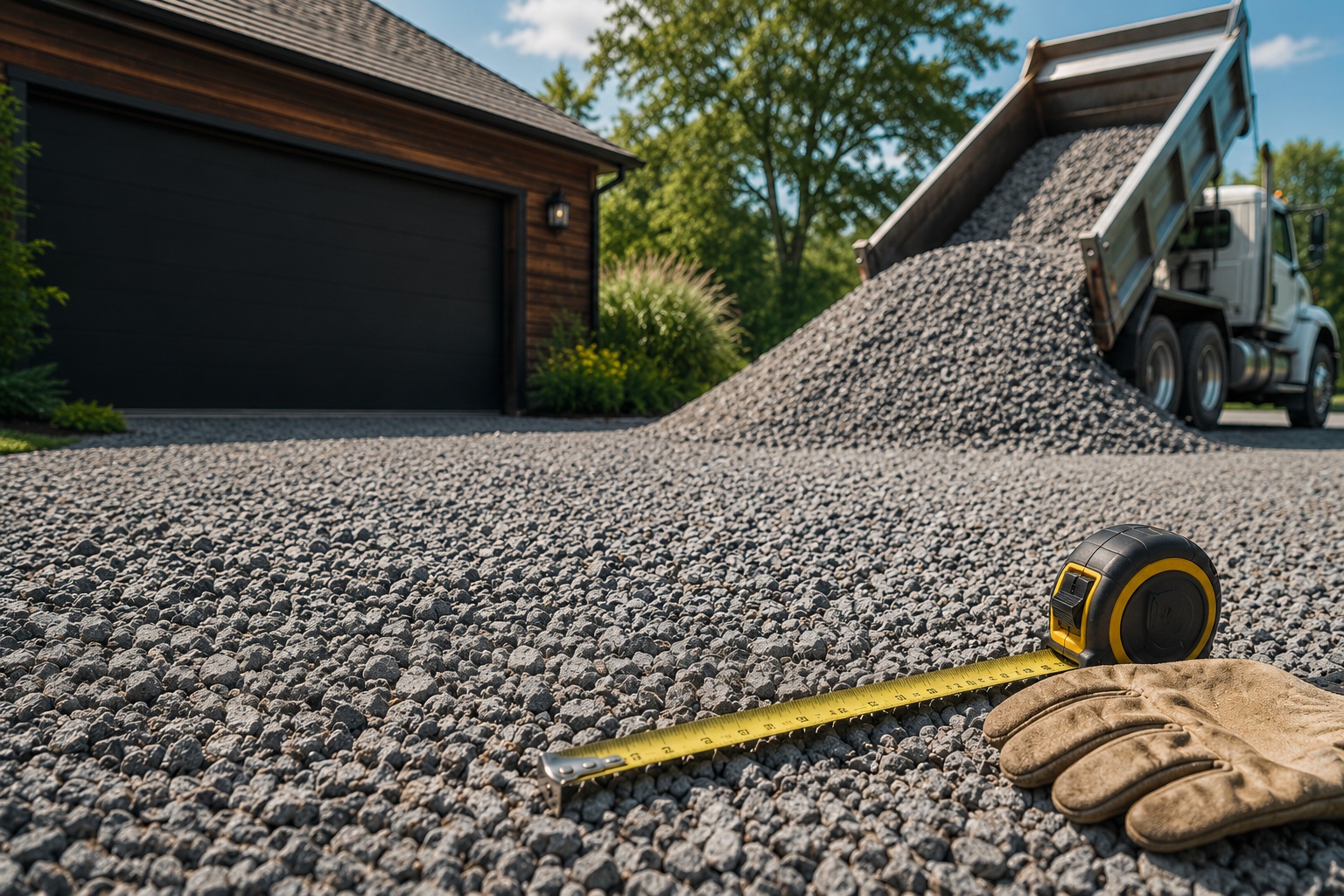
    Since deliveries are typically made by dump truck, make sure you have a clear drop-off area ready before your delivery arrives.

    Find bulk gravel near you

    Estimating gravel for a driveway comes down to three factors: your driveway dimensions, your desired depth, and the type of material you need. Taking a few minutes to calculate your needs upfront can help you avoid ordering too much or too little material.

    Loamy helps homeowners compare bulk gravel, crushed stone, crusher run, and other landscape materials from local suppliers in one place. Instead of contacting multiple businesses individually, you can compare options online and order the materials you need for delivery.

    Ready to get started? Browse gravel suppliers near you and find the right material for your driveway project.

    FAQs

    How many cubic yards of gravel do I need for a driveway?

    A typical two-car driveway measuring 20 feet by 40 feet requires approximately 10 cubic yards of gravel for a 4-inch layer. To calculate your own needs, use this formula:

    Length × Width × Depth (in feet) ÷ 27 = Cubic Yards

    Always round up slightly to account for compaction, settling, and minor grading variations.

    How deep should gravel be for a driveway?

    For a new driveway, plan for 4–6 inches of total gravel depth. If you’re refreshing an existing gravel driveway, about 2 inches is usually enough to fill minor ruts and restore the surface.

    What is the best gravel for a driveway?

    Many gravel driveways use crusher run or processed gravel as a base layer because it compacts tightly and creates a stable foundation. For the surface, ¾-inch crushed stone is one of the most common choices because it drains well and holds up to vehicle traffic.

    How much does driveway gravel cost?

    Bulk gravel pricing varies based on material type, supplier, and location. In many areas, gravel costs roughly $25–$50+ per cubic yard for material alone, while specialty stone may cost more. Delivery fees typically depend on distance and order size.

    How much does a cubic yard of gravel cover?

    A cubic yard of gravel covers about 80 square feet at a depth of 4 inches. Coverage varies depending on installation depth—the deeper the gravel layer, the less area a cubic yard will cover.

    Is it cheaper to buy gravel in bulk?

    Yes. Buying gravel in bulk is typically much more cost-effective than purchasing bagged stone. A cubic yard of gravel weighs roughly 1.3–1.5 tons, making bulk delivery the practical choice for most driveway projects.

    Can I use pea gravel for a driveway?

    Pea gravel and river rock tend to shift and scatter under vehicle traffic, making them less suitable for active driveway surfaces. They’re generally a better fit for walkways, decorative borders, and landscape beds.

  • Topsoil vs. Fill Dirt: What’s the Difference and When Should You Use Each?

    Topsoil vs. Fill Dirt: What’s the Difference and When Should You Use Each?

    If you’re planning a lawn, grading, or landscaping project, you’ve probably come across terms like topsoil, fill dirt, and screened loam. While they may sound interchangeable, these materials serve very different purposes, and choosing the wrong one can lead to dead grass, poor drainage, or a lawn that never quite takes off.

    Fill dirt is typically used for structural support and grading, while topsoil supports plant growth and lawn establishment. Screened loam, a processed type of topsoil commonly used in landscaping, falls somewhere in between and is often the preferred choice for new lawns.

    This guide breaks down the difference between topsoil and fill dirt, when to use each one, and where screened loam fits into the picture.

    Key takeaways

    • Fill dirt is best for grading, leveling, and structural support because it compacts well and contains little organic matter.
    • Topsoil supports grass, gardens, and plant growth because it contains nutrients and organic material.
    • Screened loam is a processed type of topsoil commonly used for lawns and finish grading.
    • Many landscaping projects use both: fill dirt underneath for structure and screened loam on top for growing.

    What is fill dirt?

    Fill dirt is subsoil — the layer of earth that sits below the topsoil horizon, typically starting around 12 inches below the surface. Because it comes from deeper in the ground, fill dirt has little to no organic matter, which is actually what makes it useful for certain jobs.

    With low organic content, fill dirt compacts well and holds its shape over time. It doesn’t break down, shift, or settle the way organic-rich soils do, which makes it reliable for structural applications.

    Fill dirt is the right choice when you need to:

    • Raise the grade of your yard to improve drainage or redirect water away from a foundation
    • Fill in large holes, sinkholes, or low-lying areas before finish grading
    • Build up a base layer beneath a driveway, patio, or retaining wall
    • Level a yard that has significant elevation changes

    What fill dirt is not good for: growing anything. Because it lacks organic matter and beneficial soil structure, seeds won’t germinate well in raw fill dirt, and grass will struggle to establish. If fill dirt ends up as your finished surface layer, you’ll likely end up with compacted, nutrient-poor ground that sheds water rather than absorbing it.

    What is topsoil?

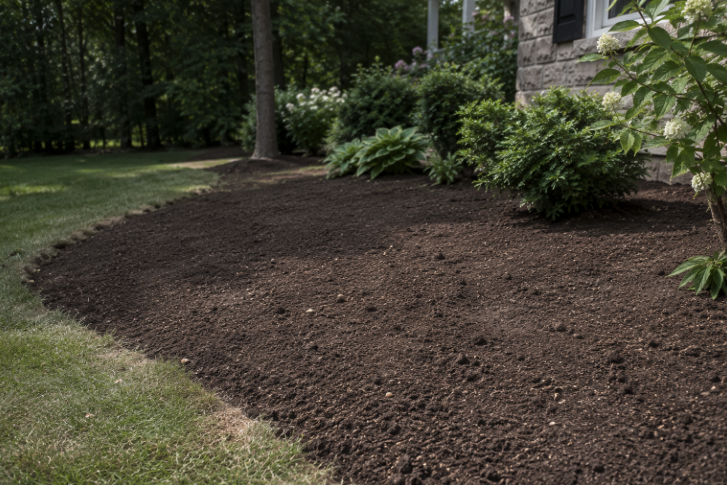
    Topsoil is the uppermost layer of earth, generally the top 2 to 8 inches, and it’s where the biological action happens. It contains organic matter, microorganisms, and the nutrient profile that plants need to grow.

    Quality topsoil has a loose, workable texture that allows for good drainage while still retaining enough moisture for root development. It supports seed germination, encourages root growth, and provides the foundation for a healthy lawn or garden bed.

    Topsoil is the right choice when you need to:

    • Establish a new lawn from seed or sod
    • Topdress an existing lawn to improve thin or bare spots
    • Amend garden beds or raise the organic matter content of existing soil
    • Create planting areas for shrubs, trees, or perennials

    One thing to know: “topsoil” is a broad term, and quality varies significantly by supplier. Bagged topsoil from a big box store and bulk topsoil from a local landscape supplier can be very different products.

    What is screened loam, and is screened loam the same as topsoil?

    Screened loam is a type of processed topsoil, but it’s worth understanding what sets it apart.

    Loam soil refers to a specific texture classification: a balanced mixture of sand, silt, and clay (roughly 40/40/20) that drains well, holds moisture, and supports strong plant growth. It’s widely considered the ideal soil texture for lawns and landscaping.

    Screened loam takes that naturally occurring loam and runs it through a screen to remove rocks, clumps, debris, and oversized particles. The result is a clean, consistent, workable material that’s easier to spread, grade, and establish turf in than unscreened alternatives.

    For homeowners doing lawn work, screened loam is often the superior choice over generic bulk topsoil because:

    • The texture is more consistent and easier to work with
    • It spreads and grades more evenly
    • The screening process removes material that can create uneven settling
    • It tends to have better drainage characteristics than heavy clay-dominant topsoils

    Topsoil vs. fill dirt: a quick comparison

      Fill dirt Topsoil / screened loam
    Organic matter Little to none Present; supports plant growth
    Best use Structural fill, grading Lawn establishment, garden beds, topdressing
    Compaction Compacts well Less compaction; better for roots
    Grows plants? No Yes
    Cost per cubic yard Generally lower Generally higher
    Typical depth As needed 4–6″ new lawn; 1–2″ topdressing

    Which one do you actually need?

    The honest answer for most homeowners: both, depending on the scope of the project.

    If your yard has significant low spots or grade issues, the right approach is to bring in fill dirt for grading, compact it, and then top it with 4 to 6 inches of screened loam or quality topsoil before seeding or laying sod.

    • Changing the grade or filling a significant low area? Start with fill dirt.
    • Establishing a new lawn on relatively flat ground? Screened loam or quality topsoil, 4–6 inches deep.
    • Topdressing an existing lawn? Screened loam, 1–2 inches max.
    • Building raised beds? A blend of topsoil and compost.

    Already know what you need? Search local suppliers on Loamy to find screened loam, topsoil, and fill dirt available for delivery in your area.

    How much topsoil do I need?

    Soil is sold by the cubic yard. To estimate: Length (ft) × Width (ft) × Depth (ft) ÷ 27 = cubic yards

    For a 4-inch layer of screened loam over a 1,000 sq ft lawn: 1,000 × 0.33 ÷ 27 = roughly 12 cubic yards.

    It’s worth getting quotes from a few local bulk soil suppliers before ordering. Prices and material quality can vary more than you’d expect even within the same region.

    The bottom line: Use the right soil for the job

    Topsoil and fill dirt serve fundamentally different purposes: fill dirt builds structure and grade, while topsoil, and screened loam in particular, creates the growing environment your lawn actually needs.

    Once you know what you need, the next challenge is finding a quality local bulk soil supplier who carries it. That’s where Loamy comes in — connecting homeowners with vetted bulk material suppliers in their area, so you can find screened loam, topsoil, fill dirt, and more.

    Getting the material right is half the battle — finding a reliable supplier is the other half. Find bulk soil suppliers near you on Loamy and skip the guesswork.

    FAQs

    Can you put topsoil over fill dirt? 

    Yes. And for many yard projects, that’s exactly the right approach. Fill dirt handles the structural work (grading, filling, leveling), and topsoil or screened loam goes on top as the growing layer. Aim for at least 4 to 6 inches of topsoil over fill dirt before seeding or laying sod.

    How deep should topsoil be for a new lawn? 

    A minimum of 4 inches is generally recommended for grass seed to establish well; 6 inches is better if you want strong root development and drought tolerance. Less than 4 inches and roots hit the compacted fill layer underneath, which limits growth.

    Is screened loam good for grass seed? 

    Yes. Screened loam is one of the best materials for grass seed establishment. The consistent texture, good drainage, and balanced soil composition create ideal conditions for germination and early root growth.

    What’s the difference between loam and topsoil? 

    Loam is a soil texture classification — a specific ratio of sand, silt, and clay that makes it ideal for growing. Topsoil is a positional term — the uppermost layer of earth, regardless of its texture. Screened loam is topsoil that happens to have loamy texture and has been processed for consistency.

    Can I use fill dirt to level my yard? 

    Yes, fill dirt is the correct material for leveling significant grade changes. For minor surface leveling (small dips, uneven lawn), a topdressing of screened loam is usually sufficient. For anything more than a few inches, fill dirt is the more stable and cost-effective choice.

    How much does a yard of topsoil cost? 

    Bulk topsoil typically runs $20–$60 per cubic yard depending on quality and region, with screened loam at the higher end of that range. Delivery fees are separate and vary by distance and supplier minimums. Getting quotes from a few local suppliers before ordering is worth the extra step.