
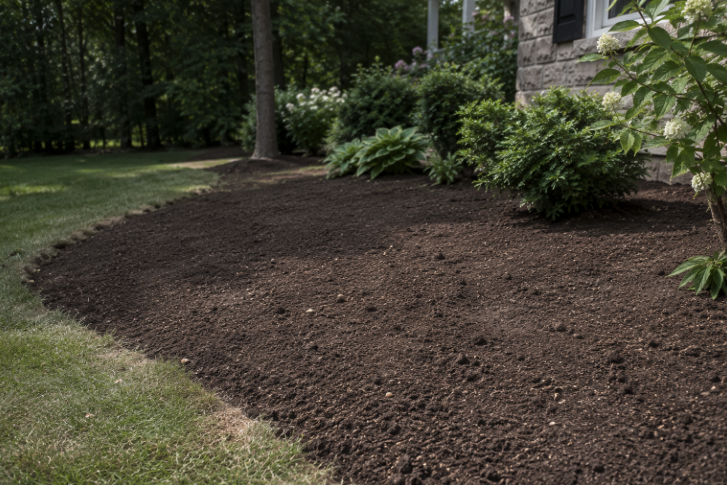
If you’re planning a lawn, grading, or landscaping project, you’ve probably come across terms like topsoil, fill dirt, and screened loam. While they may sound interchangeable, these materials serve very different purposes, and choosing the wrong one can lead to dead grass, poor drainage, or a lawn that never quite takes off.
Fill dirt is typically used for structural support and grading, while topsoil supports plant growth and lawn establishment. Screened loam, a processed type of topsoil commonly used in landscaping, falls somewhere in between and is often the preferred choice for new lawns.
This guide breaks down the difference between topsoil and fill dirt, when to use each one, and where screened loam fits into the picture.
Key takeaways
- Fill dirt is best for grading, leveling, and structural support because it compacts well and contains little organic matter.
- Topsoil supports grass, gardens, and plant growth because it contains nutrients and organic material.
- Screened loam is a processed type of topsoil commonly used for lawns and finish grading.
- Many landscaping projects use both: fill dirt underneath for structure and screened loam on top for growing.
What is fill dirt?
Fill dirt is subsoil — the layer of earth that sits below the topsoil horizon, typically starting around 12 inches below the surface. Because it comes from deeper in the ground, fill dirt has little to no organic matter, which is actually what makes it useful for certain jobs.
With low organic content, fill dirt compacts well and holds its shape over time. It doesn’t break down, shift, or settle the way organic-rich soils do, which makes it reliable for structural applications.
Fill dirt is the right choice when you need to:
- Raise the grade of your yard to improve drainage or redirect water away from a foundation
- Fill in large holes, sinkholes, or low-lying areas before finish grading
- Build up a base layer beneath a driveway, patio, or retaining wall
- Level a yard that has significant elevation changes
What fill dirt is not good for: growing anything. Because it lacks organic matter and beneficial soil structure, seeds won’t germinate well in raw fill dirt, and grass will struggle to establish. If fill dirt ends up as your finished surface layer, you’ll likely end up with compacted, nutrient-poor ground that sheds water rather than absorbing it.
What is topsoil?
Topsoil is the uppermost layer of earth, generally the top 2 to 8 inches, and it’s where the biological action happens. It contains organic matter, microorganisms, and the nutrient profile that plants need to grow.
Quality topsoil has a loose, workable texture that allows for good drainage while still retaining enough moisture for root development. It supports seed germination, encourages root growth, and provides the foundation for a healthy lawn or garden bed.
Topsoil is the right choice when you need to:
- Establish a new lawn from seed or sod
- Topdress an existing lawn to improve thin or bare spots
- Amend garden beds or raise the organic matter content of existing soil
- Create planting areas for shrubs, trees, or perennials
One thing to know: “topsoil” is a broad term, and quality varies significantly by supplier. Bagged topsoil from a big box store and bulk topsoil from a local landscape supplier can be very different products.
What is screened loam, and is screened loam the same as topsoil?
Screened loam is a type of processed topsoil, but it’s worth understanding what sets it apart.
Loam soil refers to a specific texture classification: a balanced mixture of sand, silt, and clay (roughly 40/40/20) that drains well, holds moisture, and supports strong plant growth. It’s widely considered the ideal soil texture for lawns and landscaping.
Screened loam takes that naturally occurring loam and runs it through a screen to remove rocks, clumps, debris, and oversized particles. The result is a clean, consistent, workable material that’s easier to spread, grade, and establish turf in than unscreened alternatives.
For homeowners doing lawn work, screened loam is often the superior choice over generic bulk topsoil because:
- The texture is more consistent and easier to work with
- It spreads and grades more evenly
- The screening process removes material that can create uneven settling
- It tends to have better drainage characteristics than heavy clay-dominant topsoils
Topsoil vs. fill dirt: a quick comparison
| Fill dirt | Topsoil / screened loam | |
| Organic matter | Little to none | Present; supports plant growth |
| Best use | Structural fill, grading | Lawn establishment, garden beds, topdressing |
| Compaction | Compacts well | Less compaction; better for roots |
| Grows plants? | No | Yes |
| Cost per cubic yard | Generally lower | Generally higher |
| Typical depth | As needed | 4–6″ new lawn; 1–2″ topdressing |
Which one do you actually need?
The honest answer for most homeowners: both, depending on the scope of the project.
If your yard has significant low spots or grade issues, the right approach is to bring in fill dirt for grading, compact it, and then top it with 4 to 6 inches of screened loam or quality topsoil before seeding or laying sod.
- Changing the grade or filling a significant low area? Start with fill dirt.
- Establishing a new lawn on relatively flat ground? Screened loam or quality topsoil, 4–6 inches deep.
- Topdressing an existing lawn? Screened loam, 1–2 inches max.
- Building raised beds? A blend of topsoil and compost.
Already know what you need? Search local suppliers on Loamy to find screened loam, topsoil, and fill dirt available for delivery in your area.
How much topsoil do I need?
Soil is sold by the cubic yard. To estimate: Length (ft) × Width (ft) × Depth (ft) ÷ 27 = cubic yards
For a 4-inch layer of screened loam over a 1,000 sq ft lawn: 1,000 × 0.33 ÷ 27 = roughly 12 cubic yards.
It’s worth getting quotes from a few local bulk soil suppliers before ordering. Prices and material quality can vary more than you’d expect even within the same region.
The bottom line: Use the right soil for the job
Topsoil and fill dirt serve fundamentally different purposes: fill dirt builds structure and grade, while topsoil, and screened loam in particular, creates the growing environment your lawn actually needs.
Once you know what you need, the next challenge is finding a quality local bulk soil supplier who carries it. That’s where Loamy comes in — connecting homeowners with vetted bulk material suppliers in their area, so you can find screened loam, topsoil, fill dirt, and more.
Getting the material right is half the battle — finding a reliable supplier is the other half. Find bulk soil suppliers near you on Loamy and skip the guesswork.
FAQs
Can you put topsoil over fill dirt?
Yes. And for many yard projects, that’s exactly the right approach. Fill dirt handles the structural work (grading, filling, leveling), and topsoil or screened loam goes on top as the growing layer. Aim for at least 4 to 6 inches of topsoil over fill dirt before seeding or laying sod.
How deep should topsoil be for a new lawn?
A minimum of 4 inches is generally recommended for grass seed to establish well; 6 inches is better if you want strong root development and drought tolerance. Less than 4 inches and roots hit the compacted fill layer underneath, which limits growth.
Is screened loam good for grass seed?
Yes. Screened loam is one of the best materials for grass seed establishment. The consistent texture, good drainage, and balanced soil composition create ideal conditions for germination and early root growth.
What’s the difference between loam and topsoil?
Loam is a soil texture classification — a specific ratio of sand, silt, and clay that makes it ideal for growing. Topsoil is a positional term — the uppermost layer of earth, regardless of its texture. Screened loam is topsoil that happens to have loamy texture and has been processed for consistency.
Can I use fill dirt to level my yard?
Yes, fill dirt is the correct material for leveling significant grade changes. For minor surface leveling (small dips, uneven lawn), a topdressing of screened loam is usually sufficient. For anything more than a few inches, fill dirt is the more stable and cost-effective choice.
How much does a yard of topsoil cost?
Bulk topsoil typically runs $20–$60 per cubic yard depending on quality and region, with screened loam at the higher end of that range. Delivery fees are separate and vary by distance and supplier minimums. Getting quotes from a few local suppliers before ordering is worth the extra step.