
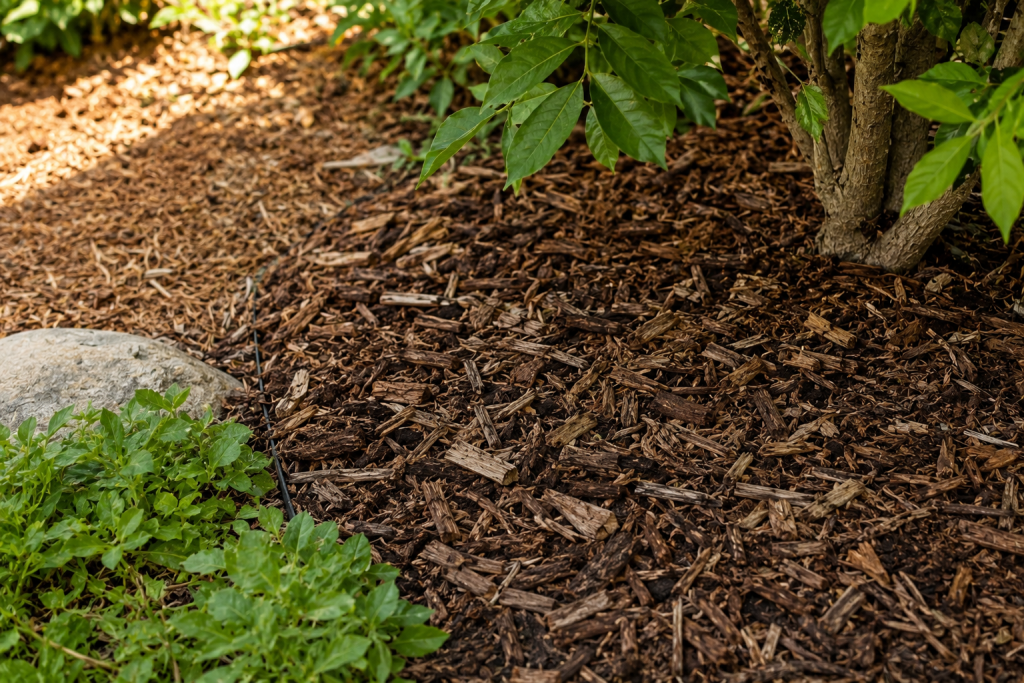
If you’ve ever stood in a garden center or scrolled through a landscaping supply site wondering whether to choose wood chips or mulch, you’ve probably realized the answer isn’t as straightforward as it seems. The two look similar, often cost around the same, and get used in overlapping ways.
Technically, wood chips are a type of mulch, but when most people compare wood chips vs. mulch, they’re usually comparing wood chips with shredded bark mulch. Understanding the main differences will help you choose the best mulch for your specific needs, whether you’re refreshing your front yard, protecting plant roots, or covering a long garden path.
This guide breaks down what separates wood chips from shredded bark mulch, where each one excels, and how to choose the best option for your landscape.
Key Takeaways
- Mulch is a broad term for any material layered on the surface of the soil to retain moisture, suppress weeds, regulate temperature, and help reduce soil erosion. Wood chips are just one type.
- Wood chips are coarser, chunkier, and slower to break down, making them an excellent ground cover for pathways, around mature trees, and naturalized areas.
- Shredded bark mulch is finer, breaks down faster, and is better suited for garden beds where appearance, plant growth, and soil health are priorities.
- Both are organic materials that improve landscapes, but each is the best choice for different applications.
- Ordering bulk mulch or bulk wood chip mulch is almost always more economical than buying bags from retailers like Home Depot.
What is mulch?
Mulch is a catchall term, not a specific material. Technically, anything you spread across the surface of the soil to protect or improve it qualifies as mulch. There are both organic and inorganic mulch options, although most homeowners choose organic materials because they gradually improve the soil as they decompose.
When most homeowners say “mulch,” they’re referring to shredded bark mulch—the dark, finely shredded material commonly used around shrubs, trees, and flower beds. It comes in different grades (fine, medium, or coarse) and may be dyed black, brown, or red, or left natural.
As one of the most popular kinds of mulch, shredded bark breaks down relatively quickly, usually within one to three years depending on the material and climate. During that time, it adds organic matter, supports soil nutrients, improves drainage, and encourages healthy soil biology.
Common mulch options include:
- Shredded hardwood bark
- Pine bark nuggets
- Shredded cedar mulch
- Dyed wood mulch (black, red, or brown)
- Composted mulch
- Pine straw
Each has advantages depending on your goals, budget, and landscape.
What are wood chips?
Wood chips are exactly what they sound like: chunks of chipped wood, often including bark, branches, and sometimes leaves, that come directly out of a chipper. Compared with shredded bark mulch, they’re coarser, less uniform, and create a more natural look.
Many wood chips come from local tree service companies, municipal tree trimming crews, or utility line maintenance projects. Others are sold in bulk by landscape supply companies. Because they’re readily available, wood chips are often one of the least expensive ground cover materials available, and in some areas, you may even be able to find a free pile of wood chips from a local arborist.
Wood chips decompose more slowly than shredded bark mulch, making them well-suited for long-term use around mature trees and along pathways.
One common misconception is that wood chips rob plants of nitrogen. Fresh wood chips can temporarily tie up nitrogen at the soil surface as they decompose, but this generally isn’t an issue when they’re used as a surface mulch. Problems are much more likely if wood chips are mixed into the soil, where decomposition can temporarily reduce nitrogen available for plant growth.
Wood chips commonly come from:
- Tree service companies
- Arborist chippings (branches, bark, and leaves)
- Municipal tree trimming programs
- Bulk landscape supply companies
Wood chips vs. mulch: Key differences
| Wood Chips | Shredded Bark Mulch | |
|---|---|---|
| Texture | Coarse, chunky, irregular | Fine to medium, uniform |
| Appearance | Rustic, natural look | Neat, finished appearance |
| Decomposition rate | Slow (2–5+ years) | Moderate (1–3 years) |
| Best choice for | Pathways, mature trees, natural areas | Garden beds, landscaping |
| Nitrogen effect | May temporarily tie up nitrogen if mixed into soil | Minimal impact |
| Cost | Often cheaper or free in bulk | Widely available in bulk |
| Weed suppression | Good | Very good |
| Moisture retention | Excellent | Excellent |
| Erosion control | Very good | Good |
When to use mulch
Shredded bark mulch is often the best mulch when appearance matters and you’re working around flowers, shrubs, or newly planted trees.
Use shredded bark mulch when:
- You’re mulching garden beds. The finer texture creates a polished appearance while gradually improving soil as it decomposes.
- You want consistent weed suppression. A 2- to 3-inch layer forms a dense physical barrier that helps reduce weed growth.
- You care about curb appeal. Dyed or double-ground mulch creates a clean, finished look that’s popular in front yard landscaping.
- You’re mulching around newly planted trees or shrubs. Keep mulch a few inches away from tree trunks to prevent excess moisture buildup.
- You’re working in vegetable gardens or annual beds. Faster decomposition adds organic matter back into the soil on a timeline that works well for seasonal planting.
Shredded bark mulch is also a good option anywhere you’re trying to reduce soil erosion while improving the appearance of your landscape.
Apply mulch at 2 to 3 inches deep. Much deeper than that can trap excess moisture and reduce airflow around plant roots.
When to use wood chips
Wood chips are often the best choice when function matters more than a polished appearance or when you’re looking for a natural, low-maintenance ground cover.
Use wood chips when:
- You’re covering pathways or walkways. The chunky texture holds up well underfoot, drains effectively, and provides a softer surface than gravel.
- You’re mulching around mature trees. Many arborists prefer wood chip mulch because it closely mimics a natural forest floor, helping retain moisture while protecting exposed plant roots.
- You’re covering large natural areas. Wood chips are an economical option for wooded spaces, slopes, and informal landscapes where a rustic, natural look fits the setting.
- You need to cover a lot of ground on a budget. Buying bulk wood chips is one of the most affordable ways to mulch large areas.
- You’re starting a no-dig garden bed. Many gardeners first lay down cardboard before adding a thick layer of wood chips to smother grass and weeds, preparing the area for future planting.
Wood chips can also help with erosion control on slopes by reducing runoff and protecting the soil surface from heavy rain.
Avoid mixing wood chips into the soil or piling them directly against plant stems or tree trunks.
The bottom line: Choose the right material for the job
Wood chips and mulch both protect soil, suppress weeds, retain moisture, and help reduce erosion, but they’re designed for different purposes. Ultimately, the best option comes down to your landscape, your goals, and your specific needs.
If you’re looking for the best mulch for flower beds, shrubs, or polished landscaping, shredded bark mulch is usually the right choice. If you’re covering pathways, mulching around mature trees, or tackling a large project on a budget, wood chip mulch is often the more practical and economical solution.
Once you’ve decided which material is right for your project, Loamy makes it easy to find local suppliers offering bulk mulch and bulk wood chips. Compare materials, pricing, and delivery options in one place, then order directly online—without the hardware store markup or the back-and-forth phone calls.
FAQs
Are wood chips better than mulch?
Neither is universally better. The best choice depends on your project. Wood chips excel around mature trees, on pathways, and in natural areas where durability and a natural appearance matter most. Shredded bark mulch is usually the best mulch for flower beds, ornamental landscaping, and front yard plantings where a tidy appearance is important.
Can I use fresh wood chips around plants?
Yes. Fresh wood chips are generally safe as a surface mulch around trees, shrubs, and perennial beds. As a best practice, avoid mixing them into the soil, where decomposition can temporarily reduce nitrogen available for plant growth.
Do wood chips attract termites or pests?
Wood chips and mulch can both provide habitat for insects, but termites are attracted to decaying wood in direct contact with a structure—not properly installed landscape mulch. Keep any mulch about 6 inches away from your home’s foundation to help reduce risk.
How deep should wood chips or mulch be?
For shredded bark mulch, 2 to 3 inches is ideal. For wood chips used around trees or on pathways, 3 to 6 inches provides the best results. Much deeper than that can trap excess moisture around plant roots.
How long do wood chips last compared to mulch?
Shredded bark mulch usually needs refreshing every one to two years.
Wood chips often last three to five years or longer, making them a good option for long-term use in low-maintenance landscapes.
Can I put wood chips in a vegetable garden?
Wood chips are best used on pathways between raised beds rather than inside planting beds. Within vegetable gardens, compost, pine straw, or finer organic mulches are typically better suited for supporting healthy plant growth.
Is bulk mulch cheaper than bagged?
Almost always. While bagged mulch from retailers like Home Depot is convenient for small projects, it becomes expensive when covering larger areas. One cubic yard of bulk mulch covers roughly 160 square feet at a 2-inch depth and typically costs much less per square foot than buying individual bags.